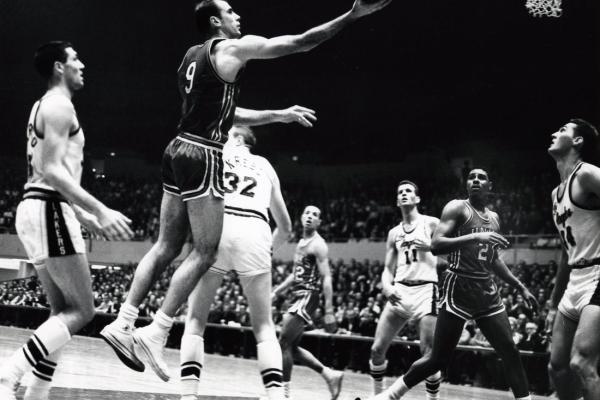
Basketball legend Bob Pettit, a Hall of Famer and first winner of the NBA’s MVP award, has died. He was 93.
The 11-time NBA All-Star and two-time college All-American at LSU died Wednesday in the New Orleans suburb of Metairie. No cause of death was divulged.
“Dad passed away very peacefully at his home in Metairie, on Wednesday, September 23,” the Pettit family said in a statement. “He was the most amazing father. The most kind, humble and gentle soul. We are so blessed to have him in our lives and we will miss him dearly.”
Pettit, a member of the NBA’s 75th Anniversary Team, was a two-time NBA MVP, a two-time scoring champion and a four-time All-Star MVP during his 11 seasons (1954-65). He also helped revolutionize the then-new power forward position and was elected to the Naismith Basketball Hall of Fame in 1971.
He was Rookie of the Year for the Milwaukee Hawks in 1954-55 before the team moved to St. Louis for the final 10 seasons of Pettit’s career. He was MVP in the 1955-56 and 1958-59 seasons and averaged 26.4 points, 16.2 rebounds and 3.0 assists in 792 career regular-season games.
The Hawks made nine playoff appearances during his career — reaching the NBA Finals four times — and won the 1957-58 championship. Pettit was named MVP of the Finals while averaging 29.3 points and 17.0 rebounds. He became the first player to score 50 points in an NBA Finals game when he hit the mark in the clinching Game 6 victory over the Boston Celtics.
The 50 points is still tied for sixth most in NBA Finals history. Elgin Baylor holds the mark of 61, set in 1962 for the Los Angeles Lakers.
In 88 career playoff games, Pettit averaged 25.5 points and 14.8 rebounds.
Pettit averaged a career-best 31.1 points in 1961-62, finishing third behind legendary Wilt Chamberlain (50.4) as well as Walt Bellamy (31.6). He averaged a career best 20.3 rebounds in 1960-61, which was good for just third behind Chamberlain (27.2) and Bill Russell (23.9).
Pettit was one of the game’s biggest stars in an era before NBA was regularly on television. He retired at age 32, partly because of a balky knee and also due to a banking opportunity.
“The Naismith Basketball Hall of Fame mourns the passing of Bob Pettit, a sleek, skilled big man who revolutionized the forward position during his career,” the Naismith Basketball Hall of Fame said in a statement. “The 11-time NBA All-Star and 2-time MVP retired as the all-time leading scorer in NBA history and left an enduring legacy. He led the St. Louis Hawks to the 1958 NBA championship over the Boston Celtics. The Basketball Hall of Fame salutes this true giant of the game.”
The Hawks moved to Atlanta ahead of the 1968-69 season and the franchise paid tribute to Pettit on Thursday.
“Beyond his accolades — including 11 All-Star selections and leading the Hawks to the 1958 NBA Championship — Bob was a true ambassador for the sport and a role model for countless fans,” the team said. “We are grateful for his contributions to our franchise and to basketball history. His retired No. 9 jersey continues to hang proudly at State Farm Arena as a lasting reminder of the impact he made on our organization. We extend our deepest condolences to Bob’s family, friends and loved ones during this difficult time.”
A native of Baton Rouge, Pettit stayed home to play college basketball at LSU. He averaged 27.4 points and 14.4 rebounds in 72 games over three seasons. He was a first-team All-American in 1953-54 when he averaged 31.4 points and 17.3 rebounds.
Pettit was a second-team All-American the previous season as a junior.
Pettit’s 31.4 scoring average was a Southeastern Conference record until another LSU legend, Pete Maravich, surpassed it with a 43.8 average in 1967-68.
LSU unveiled a statue outside of the Pete Maravich Assembly Center in 2016. A street in Baton Rouge, Bob Pettit Blvd., is also named after him.
After being the second overall pick in the 1954 NBA Draft by the Hawks, Pettit received a then-NBA record rookie record contract of $11,000.
“I had only $100 in the bank when I graduated from college,” Pettit recalled later, according to LSU, “and $11,000 looked like all the money in the world to me.”